
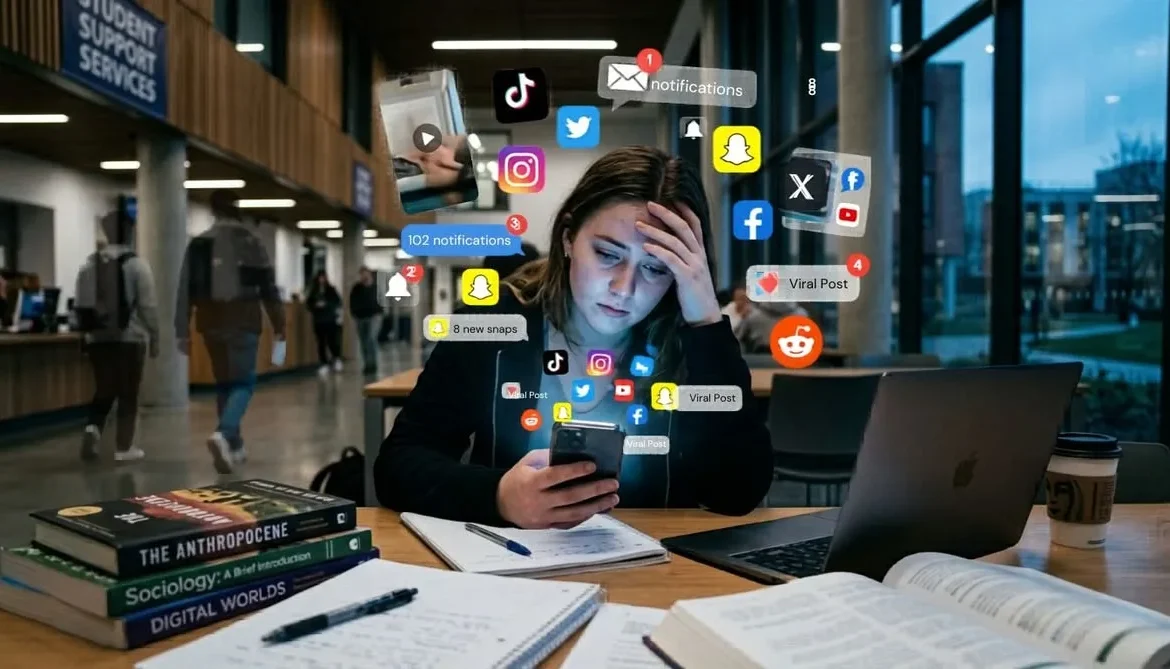
How Social Media Is Affecting Our Mental Health?
Pick up your phone right now and count how many apps are on it. Chances are, at least three of them are social media platforms. Most of us open them before we get out of bed, check them between meetings, and scroll through them when sleep refuses to come. Social media has become the background noise of modern life, and that noise is getting louder in ways that quietly damage our mental health.
The connection between social media and mental health is one of the most studied topics in modern psychology, and the findings are hard to ignore. Anxiety is up. Depression rates are climbing. Loneliness is at an all-time high despite the fact that we have never been more connected. Understanding how social media affects mental health is not about villainizing technology. It is about being honest with ourselves so we can make smarter choices.
This post breaks it all down, from the neuroscience behind your scrolling habit to the real-world effects on teens and adults, and most importantly, what you can actually do about it.
What Is Happening Inside Your Brain When You Scroll
Every notification ping, every like, every new follower triggers a small release of dopamine in your brain. Dopamine is the chemical behind motivation and reward, and it is the same system involved in gambling and sugar cravings. Social media platforms are not accidentally addictive. They are deliberately designed to activate this loop as many times per day as possible. Social media addiction is not a phrase therapists use loosely anymore. Compulsive checking, withdrawal-like anxiety when you are offline, and prioritizing your feed over real-world interactions are recognized symptoms. A 2018 study from the University of Pennsylvania found that participants who limited their social media use to 30 minutes per day showed significant reductions in loneliness and depression within three weeks. The brain is trainable, but only if you understand what is training it.
The algorithm makes this harder. It learns what keeps you emotionally engaged, and emotional content, especially content that triggers fear, envy, or outrage, holds attention longer than neutral content. Your feed is essentially a personalized emotional trigger machine, and most people have no idea that is what they signed up for.
How Social Media Affects Mental Health in Everyday Life
The Comparison Trap and Self-Worth
Nobody posts their bad days. The photos are filtered, the captions are crafted, and the version of life being presented online is a greatest hits compilation. When you scroll through that stream passively, your brain does not process it as highlights. It processes it as reality, and your reality starts to look inadequate by comparison.
Social comparison online happens involuntarily and constantly. Research published in the Journal of Social and Clinical Psychology shows that passive social media use, simply scrolling without engaging, produces the worst mental health outcomes. The people who use social media actively, posting, commenting, connecting, tend to feel better than those who only observe.
Social Media and Anxiety: The Always-On Pressure
FOMO, the Fear of Missing Out, sounds like a casual complaint until you realize it is a documented psychological stressor. Seeing your social circle gather without you, watching peers announce achievements, or simply feeling like the world is moving faster than you are creates a specific type of social media anxiety that did not exist a generation ago.
Add to that the pressure to respond instantly, to always be reachable, to maintain an acceptable online presence, and you have a recipe for chronic low-level stress that many people carry without even naming it. Anxiety and social media are now so connected that therapists routinely ask about phone habits during intake sessions.
Social Media Depression and the Loneliness Paradox
Here is the uncomfortable truth. People are more digitally connected than at any point in human history and lonelier than ever. Online friendships can be meaningful, but they rarely provide the depth that in-person relationships do. When digital interaction replaces rather than supplements real connection, social media depression tends to follow. Studies tracking adolescents over time consistently show that heavy social media use correlates with increased depressive symptoms, lower life satisfaction, and higher rates of reported loneliness, even when the person in question has hundreds of online friends. Connection without presence leaves a gap that engagement metrics cannot fill.
Cyberbullying: When the Harm Follows You Home
Traditional bullying ends when the school day does. Cyberbullying has no closing time. Harassment reaches people in their bedrooms, at family dinners, and in the moments, they most need to feel safe. The anonymity social media allows strips away social accountability, and what people say online frequently crosses lines they would never cross in person.
The mental health impact of cyberbullying is severe and well-documented. Research links it to heightened rates of depression, anxiety, self-harm, and in the most serious cases, suicidal ideation. Among teenagers this is especially acute because adolescent brains are still developing the emotional regulation systems needed to process this kind of targeted cruelty.
Effects of Social Media on Youth: Why This Generation Is Different
Every generation has faced its pressures. This one faces them with a camera in hand and an audience always watching. The effects of social media on youth are uniquely intense because adolescence is already the developmental window when identity, belonging, and self-worth are most fragile, and social media pours accelerant on all three.
Psychologist Dr. Jean Twenge analyzed data from over a million American teenagers and found that rates of depressive episodes, anxiety disorders, and loneliness began rising sharply around 2012, which is precisely when smartphone ownership became mainstream. The correlation is not perfect, but the pattern is consistent across demographic groups, income levels, and geographic regions. Image-heavy platforms like Instagram have contributed to a measurable increase in body image disorders among teenage girls. Exposure to idealized and often digitally altered appearances creates standards that are literally impossible to meet, and meeting them becomes a preoccupation that crowds out healthier pursuits. Boys face a different version of this, with social media feeding exposure to hypermasculine content and unrealistic portrayals of success that contribute to anxiety and social withdrawal.
Social Media Screen Time: How Much Is Too Much
The research does not say all social media is harmful. Light, intentional use of around 30 to 60 minutes per day appears to carry relatively low mental health risk and can provide genuine social support benefits. The problems emerge when social media screen time becomes compulsive, which happens far more easily than most people realize because the design is built to prevent natural stopping points.
Warning signs that your screen time may be affecting you include reaching for your phone the moment you feel any discomfort or boredom, feeling irritable or anxious when access is unavailable, using time online to avoid processing difficult emotions, and measuring your mood against how much engagement your posts receive. These are not character flaws. They are the intended outcomes of platforms that profit from your attention.
How to Practice Mindful Social Media Use
Deleting every app and going off-grid is not a practical solution for most people. Mindful social media use means developing a conscious relationship with these tools rather than a reactive one. The following strategies are backed by behavioral research and actually work when applied consistently.
- Set hard daily limits using your phone’s screen time settings. Start with 45 minutes and evaluate how you feel after two weeks.
- Build phone-free blocks into your day, specifically the first 30 minutes after waking and the hour before sleep. These are the windows where social media does the most damage to mood and sleep quality.
- Do a one-day digital detox each week. Research shows a single offline day per week measurably reduces reported anxiety within a month.
- Audit who you follow. If an account consistently makes you feel worse about yourself, unfollow it. Your feed is a choice you are making every day by default.
- Switch from passive scrolling to active engagement. Comment meaningfully, reach out directly to people you care about, or create something instead of consuming.
- Turn off all non-essential push notifications. Every ping is a micro-interruption that trains your brain to seek the next one.
These changes feel small individually. Combined and applied consistently, they create a fundamentally different relationship with the platforms that have been quietly shaping your emotional state.
The Bottom Line
Social media is not going anywhere, and neither is its impact on how we feel, think, and see ourselves. The research on social media and mental health is no longer preliminary. It is substantial, consistent, and concerning enough to take seriously. The platforms will not change on your behalf. They are built to capture attention, and they are extremely good at it.
But awareness changes the equation. Once you understand the mechanisms at work, the comparison loop, the dopamine feedback cycle, the algorithmic emotional targeting, you stop being a passive participant and start making actual choices. That shift is where better mental health begins. If this resonated with you, share it with someone in your life who might need to read it. And if social media’s grip on your well-being feels like more than habit, please consider speaking with a mental health professional. That conversation is worth having.